
NIST 800-53 Proposal Compliance: Mapping Controls in Responses
NIST 800-53 proposal compliance: how to map control families to RFP responses, cite the right baseline, and avoid the answer-library hallucinations evaluators flag.
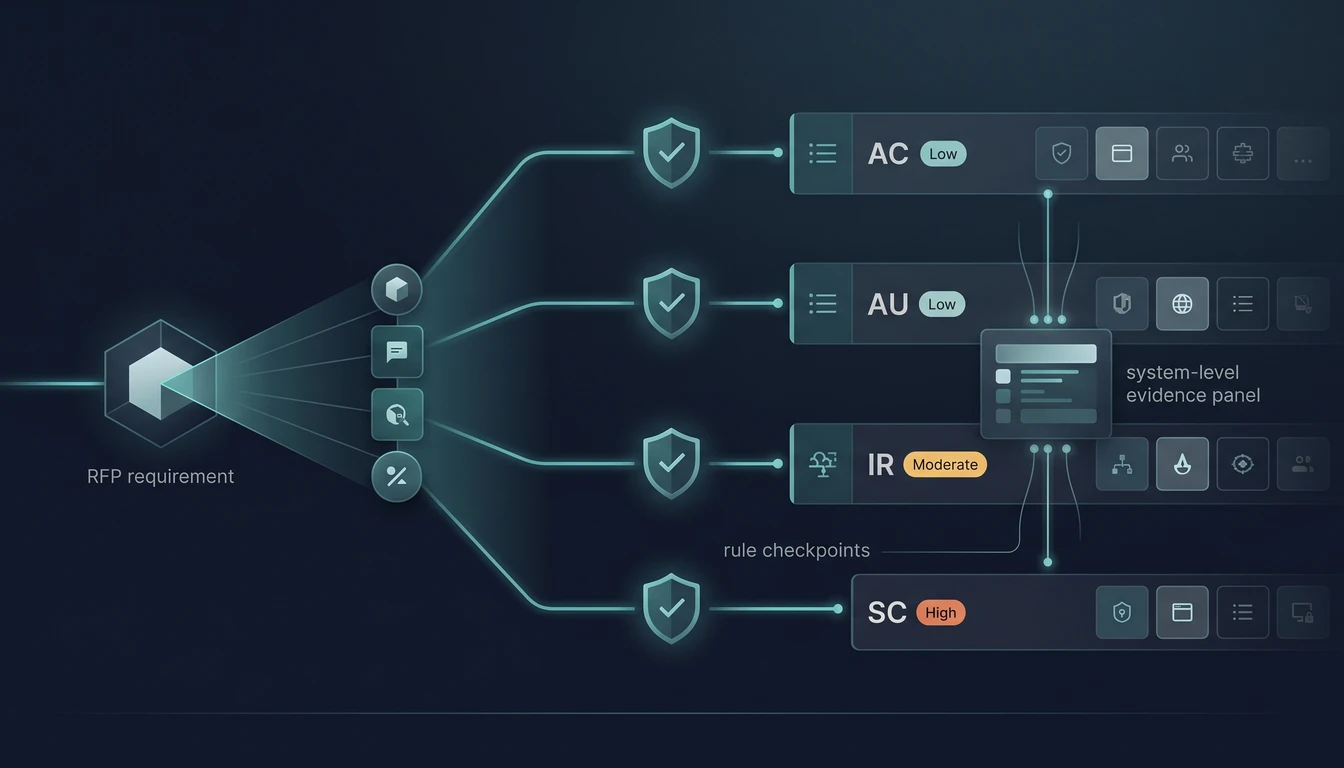
What NIST 800-53 Compliance Means in a Proposal
NIST 800-53 compliance in a proposal means responding to a federal cyber RFP with a control-by-control mapping that names the baseline (Low, Moderate, High), addresses every control in the cited control families, and ties each control implementation to a system-level evidence source. A response that asserts compliance without the mapping fails the cyber compliance review. Evaluators do not award credit for "we follow NIST 800-53." They award credit for control-level evidence.
Most commercial RFP tools were built around an answer library. Reusing past answers is fine for a sales question. It fails for a NIST 800-53 control mapping because the baseline changes, the system boundary changes, and the implementation status changes from one solicitation to the next. NIST 800-53 Revision 5 includes more than 1,000 controls and control enhancements across 20 control families (source: NIST SP 800-53 Rev. 5, Appendix C control catalog). Treating that catalog as a paragraph generator produces a response that an evaluator with a control rubric will flag as non-responsive on the cyber factor.
This post covers how 800-53 differs from 800-171, how to build a control-mapping workflow that survives audit, and what a regulatory database changes about drafting cyber RFP responses.
How NIST 800-53 Differs From NIST 800-171
The two are related and not interchangeable. Proposals routinely confuse them.
| Standard | Scope | Baseline Structure | Typical Use |
|---|---|---|---|
| NIST SP 800-53 Rev. 5 | Federal information systems | Low, Moderate, High baselines plus tailoring | Federal agency systems and federal contractor systems handling federal information at higher impact levels |
| NIST SP 800-171 Rev. 3 | Nonfederal systems handling CUI | Single baseline of 110 controls derived from 800-53 Moderate | Defense and federal contractor systems handling Controlled Unclassified Information (CUI) |
| FedRAMP | Cloud Service Providers offering services to federal agencies | Low, Moderate, High baselines aligned to 800-53 | CSP authorizations |
A DoD RFP citing DFARS 252.204-7012 generally points to 800-171. A federal civilian RFP citing FISMA, FedRAMP, or a system at FIPS 199 Moderate or High generally points to 800-53. Some solicitations cite both. Reading the solicitation correctly is step zero.
For the DFARS-driven CUI side, see DFARS 252.204-7012 and CMMC proposal compliance.
What Most RFP Tools Get Wrong About NIST 800-53
Three failure modes recur when commercial RFP tools answer 800-53 questions.
Reusing Past Answers Without Baseline Awareness
A control like AC-2 (Account Management) reads differently at Low, Moderate, and High baselines. The High baseline includes enhancements (AC-2(11), AC-2(12), AC-2(13)) the Low baseline does not. An answer library that returns "the AC-2 implementation from the last cyber RFP" without the baseline tag drops or adds enhancements that the evaluator's rubric will flag.
Confusing System Boundary
Controls apply to a system, not to a company. A response that asserts AC-3 (Access Enforcement) at the company level when the solicitation defines a system boundary covering only one product line produces an inconsistent answer. The technical volume describes one boundary. The compliance volume describes another. Evaluators reading both flag the mismatch.
Drafting Without the Control Catalog Open
NIST 800-53 Rev. 5 reorganized control families and renumbered enhancements relative to Rev. 4. Tools without a regulatory database cite Rev. 4 numbering when the solicitation cites Rev. 5 or vice versa. The result is a response that looks technically literate and reads as wrong to an evaluator who is reading the current catalog.
How to Build a NIST 800-53 Control Mapping for a Proposal
Use this sequence when an RFP cites NIST 800-53 controls or a FIPS 199 impact level.
- Confirm the baseline. Read the solicitation. FIPS 199 Low, Moderate, or High. If FedRAMP is cited, match the FedRAMP baseline.
- Define the system boundary. What systems are in scope? What information is processed? Where does the boundary end? The boundary is the unit of compliance.
- Pull the control set for the baseline from the NIST 800-53B control baselines document. Low is 149 controls. Moderate is 268 controls. High is 376 controls.
- Map each control to evidence. Reference the System Security Plan (SSP), policy and procedure documents, and the most recent assessment report. If FedRAMP, the System Security Plan and the most recent annual assessment.
- Mark control status. Implemented, partially implemented, planned, or not applicable. Not applicable requires a written justification.
- Cross-link to the technical volume. Controls do not live alone. They tie to architecture diagrams, data flow diagrams, and identity provider design. The compliance volume references the technical volume.
- Address common control inheritance. Controls inherited from a FedRAMP-authorized cloud or an enterprise authorization should be cited as inherited with the source ATO.
- Insert placeholders for unknowns. Last assessment date, ATO expiration date, POA&M counts. These belong in the response, but the model should not generate them.
- Run the final pass against the rubric. Every required control has a row. Every row has an implementation statement, an evidence reference, and a system boundary tag.
A response built this way clears the cyber compliance review on first read.
NIST 800-53 Control Families Worth Knowing
The 20 control families. Federal cyber RFPs almost always cite a subset.
| Family | Code | Topic |
|---|---|---|
| Access Control | AC | Account management, separation of duties, least privilege |
| Awareness and Training | AT | Security training, role-based training |
| Audit and Accountability | AU | Audit logging, audit record review |
| Assessment, Authorization, and Monitoring | CA | Authorization to operate, continuous monitoring |
| Configuration Management | CM | Baseline configurations, change control |
| Contingency Planning | CP | Backup, disaster recovery, business continuity |
| Identification and Authentication | IA | Identity management, multi-factor authentication |
| Incident Response | IR | Incident handling, reporting, forensics |
| Maintenance | MA | Controlled maintenance, remote maintenance |
| Media Protection | MP | Media access, marking, transport, sanitization |
| Physical and Environmental Protection | PE | Physical access, environmental controls |
| Planning | PL | System security plan, rules of behavior |
| Program Management | PM | Information security program, risk management strategy |
| Personnel Security | PS | Personnel screening, termination procedures |
| PII Processing and Transparency | PT | Privacy controls, consent |
| Risk Assessment | RA | Vulnerability scanning, risk assessment |
| System and Services Acquisition | SA | Supply chain risk, secure SDLC |
| System and Communications Protection | SC | Boundary protection, cryptographic protection |
| System and Information Integrity | SI | Flaw remediation, malicious code protection |
| Supply Chain Risk Management | SR | C-SCRM controls, counterfeit components |
Most cyber RFPs concentrate evaluator attention on AC, AU, IA, IR, SC, and SI. A proposal that handles those six families well and addresses the rest at the implementation-statement level reads competently.
Entity definition. NIST SP 800-53, formally titled "Security and Privacy Controls for Information Systems and Organizations," is the National Institute of Standards and Technology's catalog of security and privacy controls used by federal agencies and contractors to satisfy the Federal Information Security Modernization Act (FISMA).
What a Compliance-First Tool Does for 800-53
A compliance-first proposal tool treats the 800-53 catalog as structured data, not as text. That means the tool can:
- Recognize an 800-53 reference in the solicitation, identify the baseline, and pull the corresponding control set automatically.
- Decompose each control and its enhancements into compliance matrix rows tagged with the baseline.
- Map each row to a knowledge base evidence source: SSP, policy, procedure, or prior assessment report.
- Mark inherited controls with the source ATO and pull the appropriate inheritance language.
- Insert placeholders for assessment dates, ATO expirations, and POA&M counts rather than generating them.
- Generate a control trace export showing every control mapped to a response, an evidence source, and a system boundary tag.
The output is a response where the cyber volume reads consistently with the technical volume, every control has evidence, and gaps are visible before submission.
For the underlying matrix workflow, see how to build a compliance matrix.
How NIST 800-53 Tooling Compares
How drafting tools handle 800-53 control mapping.
| Capability | Generic AI RFP Tool | Compliance Posture Tool (Vanta, Drata) | Compliance-First Proposal Tool |
|---|---|---|---|
| Control catalog | Treated as text | Yes (continuous monitoring) | Yes (decomposed for drafting) |
| Baseline awareness | None | Yes | Yes |
| Mapping to RFP requirement | Manual | Out of scope | Automated at extraction |
| Evidence sourcing | Generic answer library | Internal control evidence | Knowledge base with placeholders |
| System boundary handling | None | Per system in the platform | Per solicitation |
| Output | Generated paragraphs | Compliance report | Proposal response with control trace |
Posture tools belong in the security organization. Generic RFP tools belong in the proposal team if the volume of cyber-touched RFPs is low. A compliance-first tool sits in the proposal team and bridges the two.
NIST 800-53 Proposal Compliance Checklist
Run this before submission on any RFP citing 800-53 or a FIPS 199 impact level.
- Baseline is identified (Low, Moderate, High) and matches the solicitation's FIPS 199 designation or FedRAMP baseline.
- System boundary is defined and consistent across the technical and compliance volumes.
- Every control in the baseline has a row in the compliance matrix.
- Each row has an implementation statement, an evidence source, and a status tag.
- Inherited controls are tagged as inherited with the source ATO cited.
- Common controls are distinguished from system-specific controls.
- POA&M items are referenced with a closure plan rather than omitted.
- Last assessment date and ATO expiration date are filled by a human, not generated.
- Cross-references to the technical volume use consistent language for the same components.
- Revision number (Rev. 4 or Rev. 5) matches the version cited in the solicitation.
A response that fails three or more rows usually fails the cyber compliance factor. The cyber factor is binary in most evaluations.
Tools That Help
Vercor's regulatory database includes the full NIST SP 800-53 Rev. 5 control catalog with baseline mappings, control enhancements, and the related FedRAMP and 800-171 cross-walks. When an RFP cites 800-53 or a FIPS 199 baseline, the platform extracts the requirement, pulls the appropriate control set, and decomposes it into compliance matrix rows tied to knowledge base evidence. Placeholders are inserted where assessment data, ATO dates, or POA&M counts need a human input. Pricing is published ($299 per month for Pro, $499 per month for Unlimited), and free extraction lets you run a real cyber RFP through the platform before any commitment.
For related reading, see the DFARS compliance proposal software writeup for the CUI side, GovCon proposal software for the federal contractor buyer's guide, and how to build a compliance matrix for the underlying workflow.
NIST 800-53 is a control catalog, not a paragraph generator. Proposals that map control to evidence to system boundary win cyber RFPs. Proposals that treat the catalog as text lose them.