
DFARS 252.204-7012 and CMMC Proposal Compliance
DFARS 252.204-7012 and CMMC proposal compliance: how to answer the clause in federal RFPs without hallucinating CUI handling or flow-down obligations.
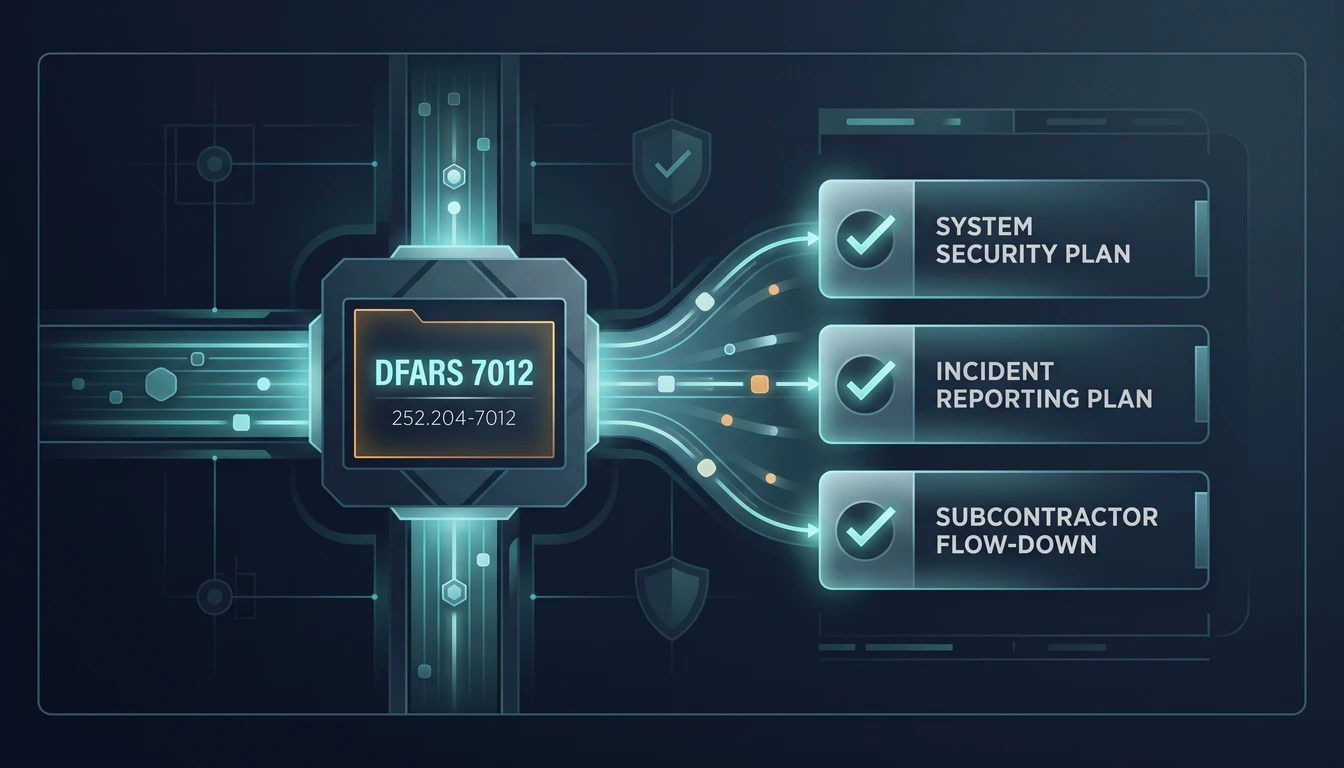
What DFARS 252.204-7012 Requires
DFARS 252.204-7012 is the "Safeguarding Covered Defense Information and Cyber Incident Reporting" clause. It obligates Department of Defense contractors to implement NIST SP 800-171 security controls on any information system that stores, processes, or transmits Covered Defense Information (CDI), report cyber incidents within 72 hours, preserve forensic evidence for 90 days, and flow the same obligations to any subcontractor handling CDI.
A proposal response to a DoD solicitation that cites this clause needs to demonstrate four things: current NIST 800-171 implementation, a System Security Plan (SSP), an incident reporting and forensic preservation plan, and a subcontractor flow-down process. Miss any of the four and the response fails compliance review regardless of the rest of the proposal's quality.
This post covers what the clause actually requires in plain language, how CMMC connects, what most RFP tools get wrong, and a practical step-by-step for answering the clause in a proposal. The audience is proposal managers and capture leads at small and mid-size defense contractors responding to DoD RFPs with a 7012 flowdown.
How CMMC Connects to the Clause
CMMC (Cybersecurity Maturity Model Certification) is the DoD's certification program for verifying that contractors actually implement the NIST 800-171 controls required by DFARS 252.204-7012. The clause is the regulatory hook. CMMC is the verification mechanism.
Under CMMC 2.0, contractors handling CDI need Level 2 certification, which requires a third-party assessment against the 110 NIST 800-171 controls. CMMC became a required DoD solicitation element in Q4 2025, with phased rollout across contracts through 2028 (source: DoD CMMC program office, Q1 2026). That means a growing share of DoD RFPs now include both the 7012 clause and a CMMC certification requirement.
For proposal purposes:
- DFARS 252.204-7012 is the clause the contract will include.
- CMMC is the proof of compliance.
- The proposal needs to answer both: what controls are in place (7012) and what certification status the company holds (CMMC).
A response that only addresses 7012 without CMMC status, or vice versa, leaves the evaluator with a partial compliance picture.
What Most RFP Tools Get Wrong About This Clause
Three failure modes show up consistently when commercial RFP tools answer 7012 questions.
Hallucinating CUI Handling
Commercial RFP tools trained on marketing language produce plausible-sounding answers about CUI handling that do not match what the company actually does. "Our infrastructure is fully NIST 800-171 compliant" is a sentence a chatbot will generate regardless of actual control implementation. Evaluators catch this on the fifth read.
Missing the Flow-Down Obligation
The clause requires the same protections to flow down to any subcontractor handling CDI. A response that describes prime controls without addressing subcontractor flow-down fails. Most RFP tools do not surface this obligation because they treat the clause as a single text block rather than a set of discrete obligations.
Confusing Clause Versions
DFARS 252.204-7012 has been revised multiple times. The 2017 version, the 2020 version, and subsequent amendments each have specific language. Tools without a regulatory database cite the current text when the solicitation references an older version, creating a mismatch evaluators flag as non-responsive.
What DFARS 252.204-7012 Actually Requires
The clause has seven substantive obligations. Every compliant proposal response addresses all seven.
| Obligation | What the Proposal Needs to Show |
|---|---|
| Adequate security on CDI systems | NIST SP 800-171 implementation across all 110 controls |
| System Security Plan (SSP) | Current SSP with scope, control implementation, and Plan of Action & Milestones (POA&M) |
| Cyber incident reporting | Process for reporting incidents to DoD within 72 hours via DIBNet |
| Forensic evidence preservation | 90-day preservation of affected media and packet capture data |
| Malicious software submission | Process for submitting discovered malware to DoD Cyber Crime Center |
| Media preservation and protection | Procedures for CDI-bearing media during incident response |
| Subcontractor flow-down | Contract language and verification that subcontractors handling CDI comply |
Miss any row and the response has a compliance gap. The evaluator's rubric treats these as binary: either addressed with evidence or not.
How to Answer the Clause in a Proposal
Use this sequence when a DoD RFP includes DFARS 252.204-7012.
- Confirm the clause version the solicitation references. Check the exact clause number and date in Section I or the FAR/DFARS listing. The current version as of Q1 2026 is the version in effect since 2020, but always verify.
- Identify the CDI scope in the contract. Which information types are covered? Which systems will process them? Which subcontractors will touch them?
- Pull your current NIST 800-171 implementation status. A compliant response references the SSP and the POA&M explicitly, not a marketing summary.
- State your CMMC status. Self-assessment, in-progress assessment, or certified at Level 2. Cite the assessment date and the certification number where applicable.
- Describe the incident reporting plan in operational terms. Who reports? What channel (DIBNet)? What internal escalation precedes the report?
- Describe the forensic preservation plan. Who preserves? What retention period? How is chain of custody maintained?
- Address the flow-down. What contract language flows the clause to subcontractors? How is subcontractor compliance verified? What happens if a sub fails to comply?
- Cross-reference the past performance section. If the company has handled CDI on prior contracts without incident, that is relevant evidence.
This sequence produces a response that maps cleanly to the evaluator's compliance rubric. Skipping any step creates a gap.
CUI Handling and Flow-Down Obligations
Two areas cause the most compliance failures. Worth treating separately.
CUI Handling Evidence
Covered Defense Information is a subset of Controlled Unclassified Information (CUI). A compliant response demonstrates how CUI is identified when it enters the company's systems, how it is marked, how it is protected in storage and transit, and how it is destroyed or returned at contract end. Tools that produce generic "we follow NIST 800-171" answers miss this level of detail. Evaluators reading a proposal against the rubric want to see the specific mechanism: "CUI is identified upon receipt via an automated email scanning rule, routed to a controlled SharePoint tenant, and encrypted at rest using FIPS 140-2 validated modules."
Subcontractor Flow-Down Verification
The clause obligates the prime to flow the same protections to subcontractors handling CDI. A response needs to show three things:
- Contract language that includes the 7012 flow-down clause in subcontracts.
- A verification process confirming subcontractor NIST 800-171 or CMMC compliance before CDI transfer.
- An ongoing monitoring process for the life of the subcontract.
Many small primes miss the verification and monitoring components. Language in the subcontract is necessary but not sufficient. Evaluators who have seen this failure mode repeatedly probe for the verification mechanism.
DFARS 252.204-7012 Proposal Compliance Checklist
Use this as a final review pass before submission.
- Clause version in the solicitation matches the version cited in the response.
- NIST 800-171 implementation status is stated with reference to the SSP and POA&M.
- CMMC status is stated (self-assessment, in-progress, or certified).
- Incident reporting process is described with DIBNet submission and 72-hour timeline.
- Forensic preservation plan covers 90-day retention and chain of custody.
- Malicious software submission process to DoD Cyber Crime Center is addressed.
- CUI identification, marking, protection, and destruction procedures are specified.
- Subcontractor flow-down contract language is referenced.
- Subcontractor compliance verification process is described.
- Subcontractor ongoing monitoring process is described.
- Past performance section includes relevant CDI-handling prior contracts without incident.
- Response cross-references the System Security Plan and any third-party assessment reports.
A response that passes this checklist clears the compliance review bar. A response that fails two or more rows typically fails evaluation on the compliance factor regardless of technical or cost scoring.
What a Compliance-First Tool Does Here
A compliance-first proposal tool treats DFARS 252.204-7012 as a structured requirement, not a text block to answer. That means:
- The clause is recognized in the regulatory database with all seven obligations decomposed.
- Each obligation becomes a row in the compliance matrix, mapped to a knowledge base section (SSP, incident response plan, subcontracting policy) and a proposal section.
- The drafting step pulls from the actual SSP and POA&M documents in the knowledge base, not from a generic answer library.
- Placeholders are inserted where the knowledge base is thin (for example, if the CMMC assessment is in progress and the company has not yet set a certification date).
- The export includes a compliance trace showing every obligation mapped to a response and a source.
See how to build a compliance matrix for the underlying workflow and the FAR clause compliance software writeup for the broader regulatory lookup model.
Tools That Help
Vercor includes DFARS 252.204-7012 and the broader CMMC requirements in its 1,400-entry regulatory database, so the clause is decomposed into its constituent obligations and surfaced inline during drafting. When a DoD RFP cites 7012, the tool extracts the requirement, maps each obligation to a compliance matrix row, and flags gaps where the knowledge base lacks evidence. Pricing is published ($299 per month for Pro, $499 per month for Unlimited), and the free extraction tier lets you run a real DoD solicitation through the platform before any commitment.
For related reading, see GovCon proposal software and the federal grant compliance checklist.
DFARS 252.204-7012 is not a clause to generate prose for. It is a clause to decompose into obligations, evidence, and a traceable compliance trail. Tools that treat it that way produce responses that pass compliance review. Tools that do not produce responses that read well and fail evaluation.