
2 CFR 200 Grant Compliance Software: Pre-Award vs Post-Award
2 CFR 200 grant compliance software: how Uniform Guidance compliance differs at the proposal stage, and why pre-award tools and post-award tools solve different problems.
Why 2 CFR 200 Compliance Splits Into Two Different Software Categories
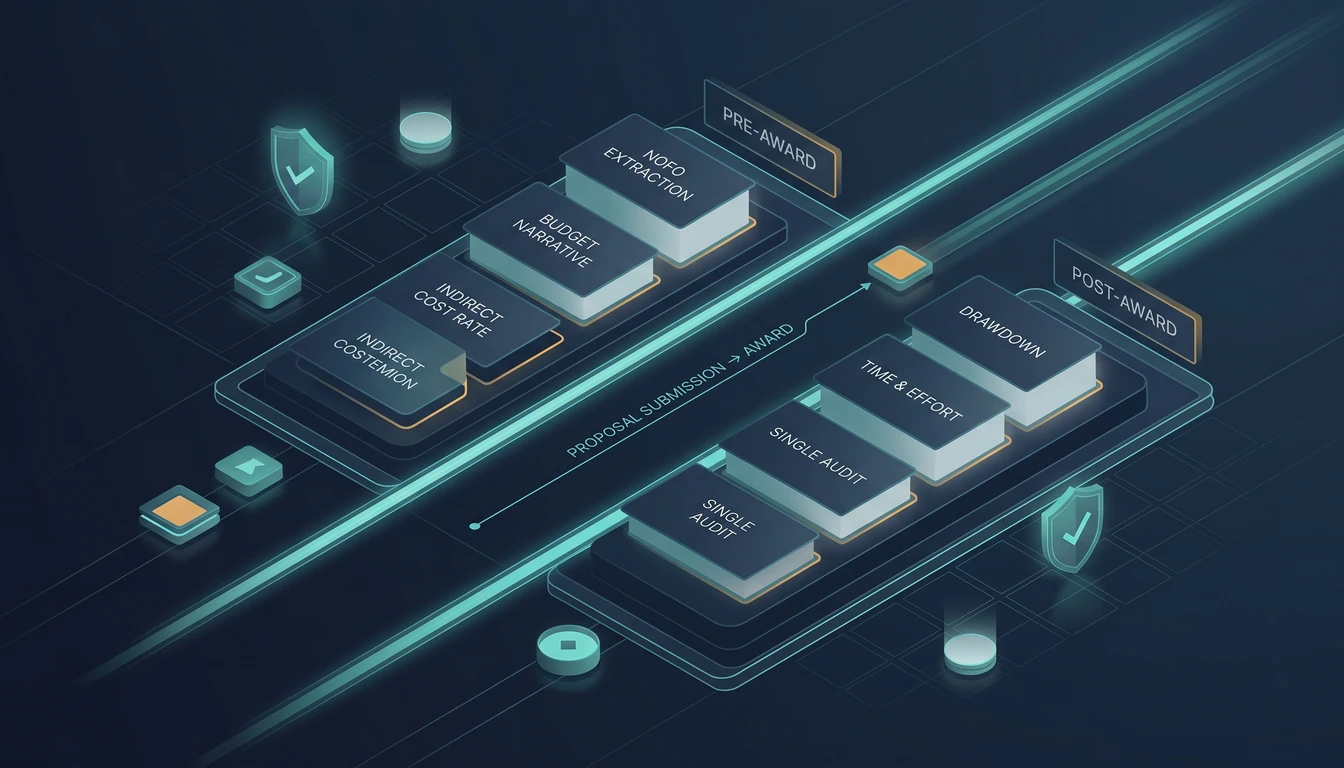
2 CFR 200 compliance splits into two software categories because the obligations split. Pre-award compliance is about writing a federal grant proposal that satisfies the Uniform Guidance cost principles, allowability rules, and program-specific NOFO terms. Post-award compliance is about drawing down funds, tracking time and effort, managing subrecipients, and surviving a single audit. These are different workflows with different buyers and different tools.
Most grant compliance software (MissionGranted, eCivis, Submittable's award management module, AmpliFund) handles post-award. They start working the day the federal award lands. The proposal stage, where 2 CFR 200 cost principles, indirect rate methodology, allowability flags, and NOFO-specific match requirements need to be translated into a budget narrative and a project description, is largely unserved by purpose-built tooling.
This post covers what 2 CFR 200 actually requires at each stage, where the existing software market sits, and how a pre-award compliance workflow differs from the post-award systems federal grant writers may already know.
What 2 CFR 200 Covers at Each Stage
2 CFR 200, the Uniform Administrative Requirements, Cost Principles, and Audit Requirements for Federal Awards, applies from the application through the award lifecycle. The obligations differ by stage.
| Stage | Subpart | Obligation |
|---|---|---|
| Pre-award (proposal) | Subpart C | Pre-Federal Award Requirements: NOFO terms, applicant eligibility, conflict of interest disclosure |
| Pre-award (proposal) | Subpart D | Post-Federal Award Requirements: described in the proposal as the management plan |
| Pre-award (proposal) | Subpart E | Cost Principles: allowability, allocability, reasonableness, indirect cost rate |
| Pre-award (proposal) | Subpart F | Audit Requirements: described as the post-award audit plan |
| Post-award | Subpart D | Financial management, internal controls, drawdown, reporting |
| Post-award | Subpart D | Procurement standards, subrecipient monitoring, real property and equipment |
| Post-award | Subpart E | Cost allowability in actuals, indirect cost rate true-up |
| Post-award | Subpart F | Single audit submission to the Federal Audit Clearinghouse |
Subparts C, D, and E all show up in proposal narratives. Subparts D, E, and F all show up post-award. Subpart E (cost principles) is the only one that materially overlaps, which is why post-award tools sometimes claim pre-award coverage but rarely deliver it.
What Post-Award Grant Compliance Software Does
Post-award systems are accounting and reporting workflows wrapped around the cost principles. The core capabilities:
- Drawdown management. Pull funds from PMS, ASAP, or G5 against the award.
- Time and effort certification. Track personnel charges to the award per Subpart E.
- Subrecipient monitoring. Risk assessment, agreement management, single audit verification.
- Indirect cost allocation. Apply the negotiated indirect cost rate to direct costs.
- Single audit preparation. Pull Schedule of Expenditures of Federal Awards data, prepare for the FAC submission.
- Federal financial reporting. Generate SF-425 and program-specific reports.
MissionGranted, eCivis, AmpliFund, and Submittable's award module sit here. They are valuable for grantees managing active federal awards. They do not write proposals.
What Pre-Award 2 CFR 200 Compliance Looks Like
Pre-award compliance is about producing a proposal that maps cleanly to the NOFO and to 2 CFR 200 cost principles before the agency reads it. The work concentrates in five areas.
Eligibility and Pass-Through Logic
Most NOFOs reference 2 CFR 200 eligibility tests, plus program-specific eligibility (state, IHE, nonprofit, tribal entity). A pre-award compliance workflow extracts the eligibility criteria from the NOFO and confirms applicant fit before the writer drafts the project description.
Allowable Cost Categories
Subpart E identifies categories of cost that are allowable, allocable, and reasonable. The proposal budget narrative needs to demonstrate that every line maps to an allowable category. Equipment over $5,000, participant support costs, computing devices, conference costs, and indirect costs each carry specific 2 CFR 200 sections that the budget narrative should reference.
Indirect Cost Rate
Applicants with a negotiated indirect cost rate agreement (NICRA) cite the rate, the cognizant agency, and the agreement effective date. Applicants without a NICRA elect the de minimis 10 percent of modified total direct costs (MTDC) under 2 CFR 200.414(f). A budget narrative that omits this election fails the cost compliance review.
Cost Sharing and Match
Many NOFOs cite a match requirement. 2 CFR 200.306 governs how cash and in-kind match are documented in the proposal. The match commitment letter, the valuation methodology, and the cost basis for in-kind contributions all flow into the budget narrative.
Conflict of Interest and Federal Award Disclosure
2 CFR 200.112 and 2 CFR 200.113 obligate disclosure of potential conflicts and certain federal awards. The proposal certifications page references these disclosures. A NOFO that incorporates these by reference makes the disclosures part of the compliance review.
Pre-Award vs Post-Award Tooling Compared
How software handles the two stages, side by side.
| Capability | Pre-Award Need | Post-Award Tool Coverage | Pre-Award Tool Coverage |
|---|---|---|---|
| NOFO requirement extraction | Required | Out of scope | Yes (extraction is the core feature) |
| 2 CFR 200 cost category mapping | Required for budget narrative | Indirect mapping only | Direct mapping by line item |
| Allowability flagging | Required for narrative QA | Post-charge only | At budget-build time |
| Indirect cost rate handling | Required (NICRA or de minimis) | Yes (negotiated rate applied) | Yes (election surfaced in narrative) |
| Subrecipient compliance | Required only at the management plan level | Yes (full lifecycle) | Disclosed in proposal narrative |
| Single audit | Not applicable | Yes | Not applicable |
| Federal financial reporting | Not applicable | Yes | Not applicable |
| Drawdown | Not applicable | Yes | Not applicable |
A team handling federal awards end-to-end usually needs both. A team responding to NOFOs from RFPs and grant solicitations primarily needs the pre-award category.
What 2 CFR 200 Pre-Award Compliance Software Should Do
A pre-award compliance workflow needs five capabilities. They are absent from most existing tools.
- Extract NOFO terms including eligibility, match, indirect cost rate treatment, page limits, and 2 CFR 200 references in the program rules.
- Decompose 2 CFR 200 cost principles into allowable, unallowable, and conditional categories with the section reference for each.
- Map budget line items to cost categories. Personnel to 200.430, fringe to 200.431, equipment to 200.439, indirect costs to 200.414. Flag lines that do not map cleanly.
- Surface the indirect cost rate election. NICRA citation or de minimis 10 percent MTDC declaration with the appropriate budget narrative language.
- Generate a compliance trace showing every NOFO requirement and 2 CFR 200 reference mapped to a proposal section.
The output is a proposal where the budget narrative reads correctly to the agency reviewer and a compliance trace lets the proposal manager verify coverage before submission.
How to Build a 2 CFR 200 Compliant Federal Grant Proposal
Use this sequence on any federal NOFO that incorporates 2 CFR 200.
- Extract the NOFO requirements including eligibility, page limits, match, indirect treatment, attachments list, and any program-specific 2 CFR 200 references.
- Confirm eligibility at the entity level. Does the applicant type match the NOFO criteria?
- Build the budget by cost category mapped to 2 CFR 200 Subpart E sections. Personnel, fringe, travel, equipment, supplies, contractual, participant support, indirect.
- Apply the indirect cost rate treatment. NICRA with cognizant agency and date, or de minimis 10 percent MTDC under 200.414(f).
- Document the match commitment with letters of support, valuation methodology for in-kind, and the cost basis.
- Draft the project description with explicit references to allowable methods and cost categories.
- Draft the management plan including subrecipient monitoring approach if subawards are anticipated, internal controls, and the single audit posture.
- Compile the certifications including conflict of interest disclosure (2 CFR 200.112), federal award disclosure (2 CFR 200.113), and any program-specific certifications.
- Run the final compliance pass against the NOFO requirement matrix. Every requirement maps to a section. Every cost line maps to an allowable category. Every certification is signed.
A proposal built this way clears the agency cost compliance review and the program review on first read.
Entity definition. 2 CFR 200, formally titled "Uniform Administrative Requirements, Cost Principles, and Audit Requirements for Federal Awards," is the consolidated federal regulation that governs how federal grant funds are applied for, awarded, managed, and audited across all federal awarding agencies.
Statistic Worth Noting
Federal agencies awarded $1.2 trillion in grant funding in fiscal year 2024, of which roughly 60 percent flowed to state and local governments and the remainder to nonprofits, institutions of higher education, and tribal entities (source: USAspending.gov fiscal year 2024 summary). Every dollar of that flow runs through 2 CFR 200. Pre-award compliance failures show up as either non-responsive determinations (proposal rejected) or budget cuts the agency makes during negotiation. Both reduce the recoverable amount.
Tools That Help
Vercor's grant mode handles 2 CFR 200 pre-award compliance directly. The platform extracts NOFO requirements at upload, maps the program's 2 CFR 200 references into compliance matrix rows, decomposes the budget into Subpart E cost categories with allowability flags, and surfaces the indirect cost rate election in the budget narrative. The 1,400-entry regulatory database covers 2 CFR 200 Subparts A through F, plus agency-specific supplements. Pricing is published ($299 per month for Pro, $499 per month for Unlimited), and free extraction lets you run a real federal NOFO through the platform before any commitment.
For related reading, see the federal grant compliance checklist, NOFO response software, and the GovCon proposal software writeup for the federal contractor side of the same compliance ecosystem.
Pre-award and post-award are different problems. The post-award category is mature. The pre-award category is open. A grant team that wants 2 CFR 200 compliance baked into the proposal, not retrofitted after the award, needs a pre-award tool.