
DFARS Compliance for Proposal Writers: What Most Tools Miss
DFARS compliance proposal software: how to inject DFARS clause context into RFP responses without hallucinating, missing flow-downs, or citing the wrong clause version.
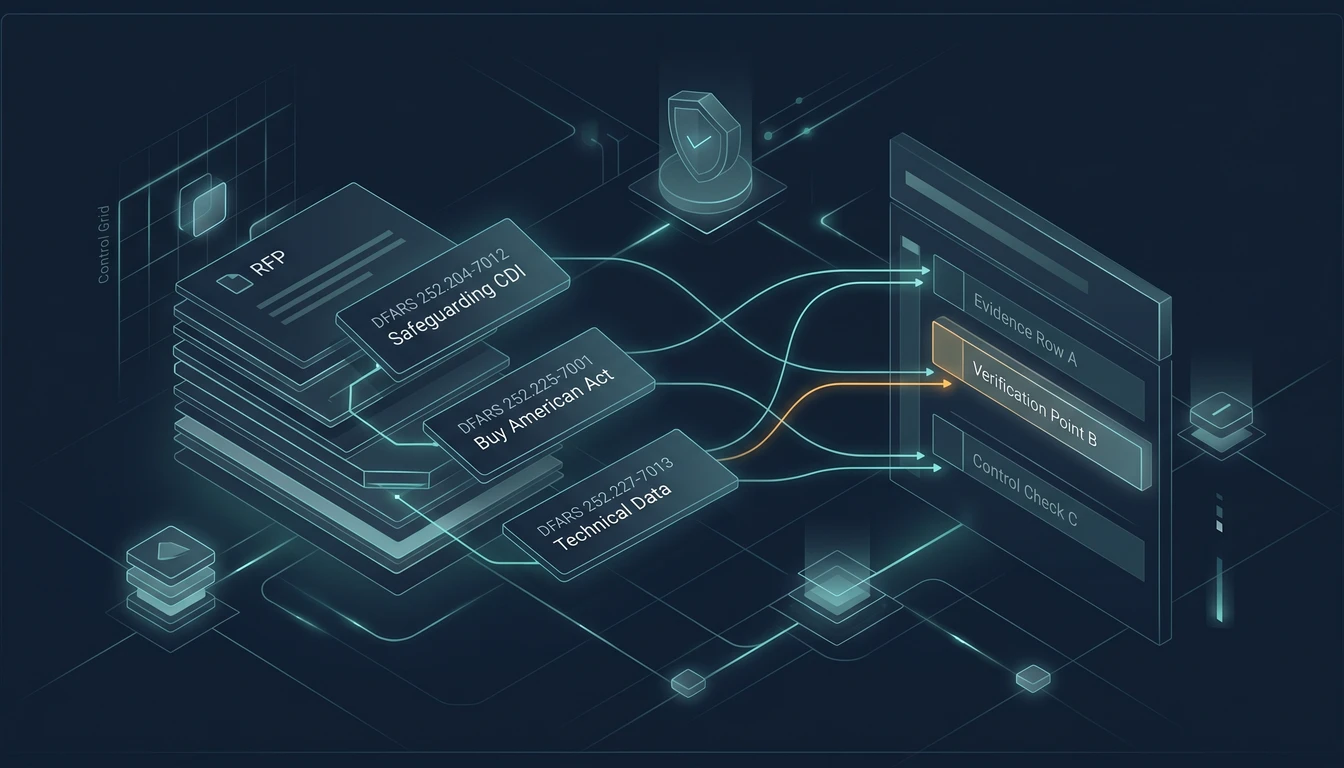
What DFARS Compliance Means in a Proposal
DFARS compliance in a proposal means responding to every DFARS clause cited in a Department of Defense solicitation with concrete evidence, the correct clause version, and obligations addressed at the sub-paragraph level. A proposal that names the clause without addressing its discrete obligations fails the compliance pass even when the technical and cost responses are strong.
Most commercial RFP tools treat DFARS clauses as opaque text. They drop a clause number into a response section and let a writer paste a stock paragraph from the answer library. Evaluators trained on the DoD Source Selection Procedures catch this in two reads. The result is a non-responsive determination on the compliance factor, which is binary and irrecoverable in a fixed-deadline solicitation.
This guide covers what DFARS clauses commonly show up in DoD solicitations, what most tools get wrong, and how a compliance-first workflow handles clause lookup, version tracking, and flow-down obligations during drafting rather than at the QA pass.
The DFARS Clauses That Show Up Most in DoD RFPs
A small set of DFARS clauses appears in the majority of DoD solicitations. Knowing which obligations each carries shortens the gap between extraction and a compliant response.
| Clause | Subject | Obligation Type |
|---|---|---|
| 252.204-7012 | Safeguarding Covered Defense Information and Cyber Incident Reporting | NIST 800-171, 72-hour incident reporting, flow-down |
| 252.204-7019 | Notice of NIST SP 800-171 DoD Assessment Requirements | Self-assessment score posted in SPRS |
| 252.204-7020 | NIST SP 800-171 DoD Assessment Requirements | Subcontractor assessment verification |
| 252.204-7021 | Cybersecurity Maturity Model Certification Requirements | CMMC level certification before award |
| 252.225-7001 | Buy American and Balance of Payments Program | Country-of-origin certifications on supplies |
| 252.227-7013 | Rights in Technical Data, Noncommercial Items | Data rights assertion table |
| 252.227-7014 | Rights in Noncommercial Computer Software | Software rights assertion table |
| 252.211-7003 | Item Unique Identification | UID marking and registry submission |
| 252.232-7003 | Electronic Submission of Payment Requests | WAWF submission process |
| 252.243-7001 | Pricing of Contract Modifications | Pricing methodology disclosure |
Each row is a discrete compliance obligation. A response that handles the cybersecurity clauses well but misses the data rights assertion table on a contract that has one is not a compliant response. The evaluator's rubric is column-by-column.
What Most RFP Tools Get Wrong About DFARS
Three failure modes show up consistently when commercial RFP tools answer DFARS questions.
Treating the Clause Number as Text
A clause is a structured set of obligations, not a paragraph. DFARS 252.204-7012 has seven substantive obligations, ranging from NIST 800-171 implementation to subcontractor flow-down (source: DoD Procurement Toolbox, DFARS Appendix Part 252). Tools that drop the clause number into the response and let the writer freehand a paragraph routinely miss two or three of those obligations. A compliance-first tool decomposes the clause into rows in the compliance matrix.
Citing the Wrong Version
DFARS clauses change. The 2017 cyber incident reporting language differs from the 2020 revision. Solicitations cite the version that flows from the Procurement Integrated Enterprise Environment (PIEE) at the time the RFP is issued. Tools without a regulatory database cite whichever version was most recently scraped, which is rarely the version the evaluator is reading from.
Missing Flow-Down Obligations
Several DFARS clauses (7012, 7020, 7021, 225-7001) carry explicit flow-down language to subcontractors handling the same scope. RFP tools designed around an answer library treat each clause as a single response artifact. They do not surface the flow-down obligation to the subcontracting plan section. The proposal looks complete to the writer and reads as non-compliant to the evaluator.
How a Regulatory Database Changes Drafting
A regulatory database in a proposal tool is not a search feature. It is a structured representation of every clause as a set of obligations, tied to drafting context and evidence sources.
When the database is integrated into drafting:
- Clause extraction at upload identifies every DFARS reference in the solicitation and its version.
- Each clause expands into its sub-paragraph obligations as compliance matrix rows.
- The drafting step pulls evidence from the knowledge base (SSP, POA&M, subcontracting plan, IUID procedures) instead of from a generic answer library.
- Flow-down obligations cross-link to the subcontracting plan section automatically.
- Placeholders are inserted where the knowledge base lacks evidence rather than the model hallucinating a value.
The output is a response where every clause maps to evidence, every obligation maps to a row, and every gap is visible before submission rather than after debrief.
For the underlying matrix workflow, see how to build a compliance matrix.
How to Inject DFARS Clause Context Into Drafting
Use this sequence when a DoD RFP cites DFARS clauses.
- Confirm the clause list and versions in Section I or the FAR/DFARS listing. Note every DFARS reference and the date in effect at solicitation issue.
- Decompose each clause into its sub-paragraph obligations. For 252.204-7012 that is seven rows. For 252.227-7013 that is the assertion table plus the noncommercial item identification.
- Map each obligation to a knowledge base source. The SSP for 7012 (a). The CMMC certificate for 7021. The IUID procedure for 211-7003. If a source does not exist, mark the row as a gap and assign an owner.
- Cross-link flow-down obligations to the subcontracting plan and the small business participation plan where relevant. A 7012 flow-down without a subcontracting plan reference is incomplete.
- Pull the version-correct clause text when drafting. The response should reference the clause as cited in the solicitation, not the most recent revision.
- Insert placeholders, not generated values. CMMC certification dates, SPRS scores, and FCL clearance levels should be filled by a human, not a model.
- Run a final compliance pass against the rubric. Every clause becomes a row. Every row needs a response cell, an evidence cell, and a section reference cell.
A response built this way clears the compliance review bar without a separate audit step.
DFARS Compliance Tooling Compared
How drafting tools actually handle DFARS varies more than their marketing pages suggest.
| Capability | Generic AI RFP Tool | Compliance Posture Tool | Compliance-First Proposal Tool |
|---|---|---|---|
| Clause recognition | Treats clause number as text | Out of scope (covers controls, not RFPs) | Decomposes clause into obligations |
| Version tracking | Latest available | Not applicable | Version cited in solicitation |
| Flow-down surfacing | Manual | Not applicable | Auto-linked to subcontracting plan |
| Evidence sourcing | Generic answer library | Internal control library | Knowledge base with placeholders |
| Output | Generated paragraph | Compliance report | Response with traceable evidence trail |
The middle column tools (Vanta, Drata, Secureframe) are valuable for posture monitoring. They do not produce a proposal response. The first column produces a paragraph that reads well and fails compliance review. The third column produces a response that maps to the evaluator's rubric.
DFARS Proposal Compliance Checklist
Run this pass before submission on any DoD RFP citing DFARS clauses.
- Every DFARS clause in the solicitation is listed with its cited version in the response cross-walk.
- 252.204-7012 obligations are addressed across all seven sub-paragraphs.
- SPRS self-assessment score is referenced if 252.204-7019 or 7020 is cited.
- CMMC level and certification status is referenced if 252.204-7021 is cited.
- Country-of-origin certifications are addressed if 252.225-7001 is cited.
- Data rights and software rights assertion tables are included if 252.227-7013 or 7014 is cited.
- IUID procedures are referenced if 252.211-7003 is cited.
- Electronic invoicing process is referenced if 252.232-7003 is cited.
- Flow-down clauses cross-link to the subcontracting plan and small business participation plan.
- Each clause row has an evidence source identified in the knowledge base or a placeholder owned by a named person.
- Version of each clause matches the version in the solicitation, not a later revision.
A response that fails two or more rows typically receives a non-responsive determination on the compliance factor.
Entity definition. DFARS (Defense Federal Acquisition Regulation Supplement) is the DoD's supplement to the Federal Acquisition Regulation, codifying procurement rules specific to defense contracts at 48 CFR Chapter 2.
Tools That Help
Vercor includes 1,400 regulatory entries covering FAR Part 52, DFARS Part 252, NIST 800-171 and 800-53 control families, and CMMC practice mappings. When a DoD RFP cites a DFARS clause, the platform extracts the clause and version, decomposes it into sub-paragraph obligations as compliance matrix rows, pulls evidence from the knowledge base, and flags flow-down obligations against the subcontracting plan section. Pricing is published ($299 per month for Pro, $499 per month for Unlimited), and free extraction lets you run a real DoD solicitation through the platform before any commitment.
For related reading, see GovCon proposal software, DFARS 252.204-7012 and CMMC proposal compliance, and the FAR clause compliance software writeup for the broader regulatory lookup model.
DFARS clauses are not paragraphs. They are obligations. Tools that treat them as obligations produce responses that pass compliance review. Tools that treat them as text produce responses that read well and lose on the binary factor that ends the evaluation.